WILD FOR WILD GARLIC
We were a mile away, inching our way up a one-track British lane bordered by freshly sprouting hedges, when suddenly my nose twitched. And twitched again. I recognized the fragrance immediately and knew that we were close to Llwyn Ffranc Farm, home to fields upon fields of wild garlic.
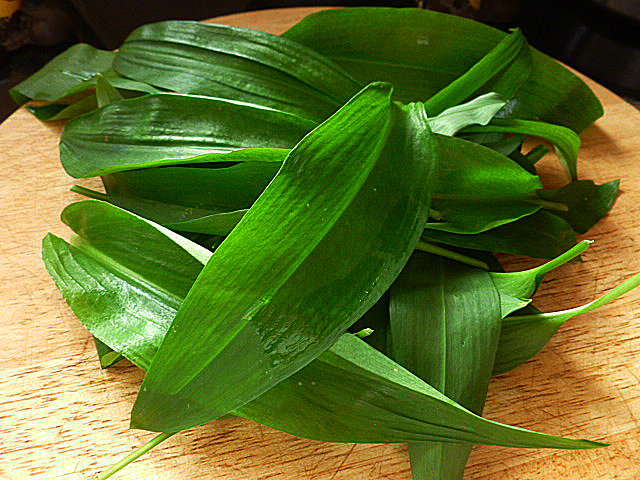
Wild Garlic, freshly foraged.
We’d met Stephen Powell, one of the forces behind the Community Forest Farm at Llwyn Ffranc, several weeks before at his stall in the Abergavenny Farmer’s Market. Knowing he was the wild garlic man, and expecting to see baskets of white and pink bulbs, we were surprised when Stephen pointed to a pile of rich green leaves spread out on the table. Wild Garlic. Lovely to meet you. Now what do I do with you?Stephen explained that, like many herbs, wild garlic is perfect in stews, sauces and especially mashed potatoes. Paul grinned immediately, licked his lips, and before you could say Llwyn Ffranc, a white paper bag containing the shining leaves was in our hand.
Yes, laced with the chopped wild garlic, the potatoes were delicious. But we knew there was something more exciting ahead as Stephen had invited us to go foraging during the Wild Garlic Celebration.
Hence, the drive north of Abergavenny, to the base of the Skirrid Mountain. There, we parked the car in a field and headed to the stone house to await our guide who would take us into the woods! An assorted group gathered, all properly prepared to hike into the hills, and all carrying bags to fill with their harvest. For a city girl like me, THIS WAS EXCITING!
I must mention, Paul and I have tried many times to plant and harvest our own vegetables. My tomato plants came with large green worms attached. Paul’s potatoes got rot. Our mint, known to take over a garden if you let it, shriveled up and died. We love the thought of planting and harvesting, but actually being successful at it is beyond our talents. So, foraging someone else’s field is a perfect pastime for us.
Up the hill we marched, keeping to the tail end of the group as Paul’s gout and other maladies afflicting the elderly (!) were acting up. Slopping through mud, inching up the inclines as if we had skis on our feet, and totally messing up my new wellies and their leopard-trimmed inserts, we finally made it to the wild garlic fields.
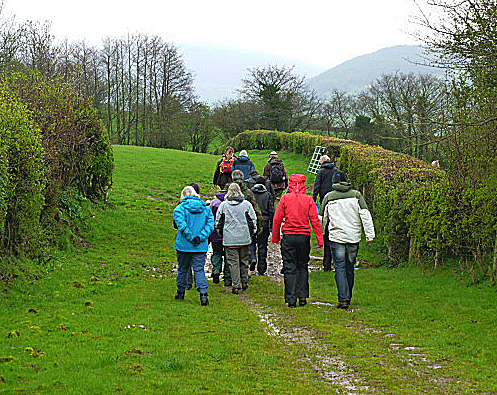
Heading for the hills!
The green carpet of leaves was so lush I wanted to lie down and roll in it, but that would have been frowned upon I’m sure. So I contented myself by squatting and picking the leaves, placing them gently in my bag, and moving over and across the ravines weaving in and out of the hillside.Soon the group was ready to climb back down the mountain, but this time, we led the brigade and slid our way down, stopping now and again to admire the bluebells and buttercups, the baby lambs and to listen to the silence. A forest is a wondrous place.
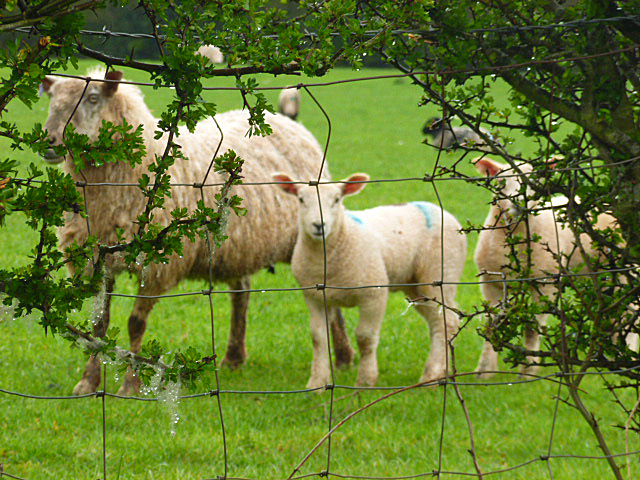
Up close and personal!
A warm cup of tea was waiting for us as we approached the farmhouse, followed by a cauldron of nettle and wild garlic soup, wild garlic pesto, squirrel pate (yes, I DID try it!), and apple and sloe jam. These were new experiences for this Yank, and as the sun slowly slid behind the Skirrid, I know I’d had an afternoon to treasure.A footnote to our day: we couldn’t get out of the field when we tried to leave. The mud had gotten soggier and our tires dug deeply into the muck. It took a team of fellow foragers to push our little car out, but not before soaking us, and them, in the rich, brown soggy earth that provides the nutrients for the wild garlic. We hit the car wash, wallowed in a bubble bath when we got home, and made mashed potatoes and wild garlic to go with our dinner! That, and a glass of wine, rounded out our experience of foraging on a mountainside. What a heavenly day!
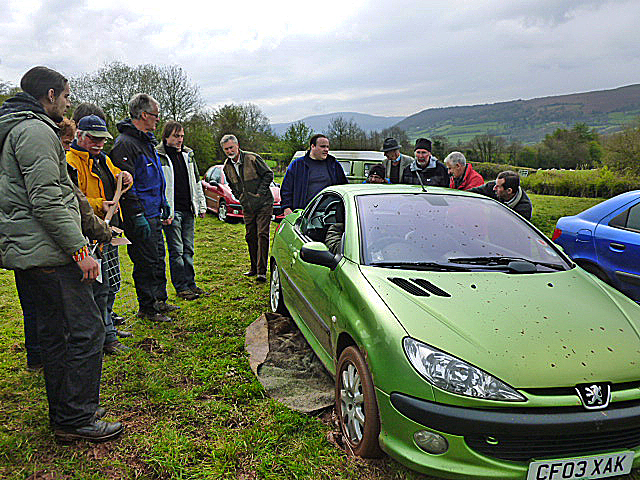
Umm, what do we do now?
FAB-LUS!
One of the joys of living amongst the Welsh people is listening to them speak. Unlike the “lockjaw” of the posh English, whose lips and jaws remain steadfast while words squeak through the slit that’s just above their chin, the Welsh relish each word and phrase, and offer them up in a sing-song manner that’s music to the ears, even if we can’t understand what they’re saying!
We’ve moved again. Don’t ask. Just know that water gurgling up into our shower every time we flushed the toilet wasn’t appealing. So we packed up our thousand-pounds plus of treasures and moved to an area of Wales that’s less prestigious than the “shire” in which we lived for the past seventeen months. We’re now residents of “The Valleys,” a name my Los Angeles friends will understand, and one that designates deep-rooted Welsh history. The Valleys are a microcosm of all that is good about Wales.
The Valleys is where Wales came of age and prospered. At least some Welsh prospered while the majority labored and aged. Veins of black gold, coal, gave birth to the area’s heritage. Below the velvet green carpets that now cover the rolling hills, remnants of the wonton destruction of the hillsides in the quest for riches remain. All that is left of the valleys are sleeping coal mines clinging to past glories, a few noble sculptures edging the roads and a tourist attraction. Remembrances of “How Green Was My Valley” continuously pop into mind, but Malibu was never a true substitute for the wealth and beauty of South Wales.
Houses, for the most part, are attached, terraced, made of stone and small. They have stood for over one hundred years and snake up and over the hills everywhere you look. These homes belong to the working classes. The people who put this country on the map. And these are the people who sing Welsh when they speak. Who acknowledge something wonderful with the simple, two-syllable “fab-lus.”
Words tumble out of their mouths that I don’t understand, but I smile anyway, enjoying all the musical notes they hit within each sentence. Just hearing them speak makes me break out in a smile. These are the Welsh who are the sugar in my tea.
They are friendly, these Valley Welsh. They say hello. They stop for a chat. There is no pretense erupting from their demeanor. They are real.
We weren’t in our house for one day when a card was pushed through our mail slot welcoming us to the neighborhood. In the fifteen months we lived on the “posh” side of the mountain, the only people who spoke with us were our lovely landlords and the kind, sweet men who worked for them. Talking to the sheep was joyous, but it lacked in engaging conversation.
I went for a walk the other day. Down our hillside, up an Alp and into the tiny village to buy our weekend newspapers. I passed a mudded field where cows stood. Another field held two fuzzy ponies. Baby calves snuggled into their mothers, and in the distance, large white specks were followed by frolicking smaller specks. I passed rusted fences adjacent to hillside gardens and neatly manicured lawns. Daffodils and crocuses (i?) were standing at attention in some gardens while barren blackberry bushes still lay dormant.
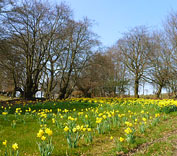
A "Fab-Lus" field of daffodils in "The Valleys."
An old lady sitting on her stoop waved and said hello. A young man stumbling out of one of the terraced homes gave a mumbled greeting before climbing into his car. A teenage girl with angst written all over her face (what teenager doesn’t have angst on her face?) was the only person I passed who didn’t offer commentary on the day. On my way back home an old man, out of breath from climbing the uphill side of the Alp was carrying a walking stick. He stopped and smiled his greeting: “Bee-yew-tee-ful day, in’nt, luv?”I stopped for a moment, smiled back at him in appreciation, and the only word that popped out of my mouth was: “FAB-LUS!” And it was.
THE SECRET SUPPER CLWB (WELSH STYLE)
The well-dressed crowd arrived at the Grade II Listed and historic Raglan Barracks, a sprawling stone-walled military headquarters set atop a crest overlooking glittering Newport, South Wales. Members of a male voice choir and several men dressed in kilts were roaming the grounds in search of the Sergeants’ Mess, while those of us who were “dressed to impress” found the Officer’s Mess. All, I might add, were in high spirits. It helped that Wales had squeaked past rival England in an important rugby match that afternoon, and the Welsh are known for redefining “celebratory mood.” They are not timid in their outpouring of joy when one of their teams wins a duel, regardless of their dress. Air punches, back slaps and outcries of “Oy, did you see….” brought the Welsh brand of civility to all those gathered.
We were the inaugural guests of The Secret Supper Clwb, (don’t you just love the Welsh spelling?!) a formal dining occasion produced by impresario Phillip Mungeam and chef Emma Evans. So named because the location is held secret until just days before the event, the Clwb promises exotic, unusual and even historic locations for the main event of expertly prepared gourmet meals and festive entertainment.
Sipping sparkling aperitifs, the majority of the guests were strangers to each other, but polite conversation (amid the back slaps) and gentle introductions were made as a harpist played in the background. Suddenly the genteel mood of the richly paneled officer’s bar was jolted out of its cocoon when a rapping on the table was followed by a belting baritone voice. “Dinner will be served in five minutes,” our master of ceremonies announced, or rather, bellowed.
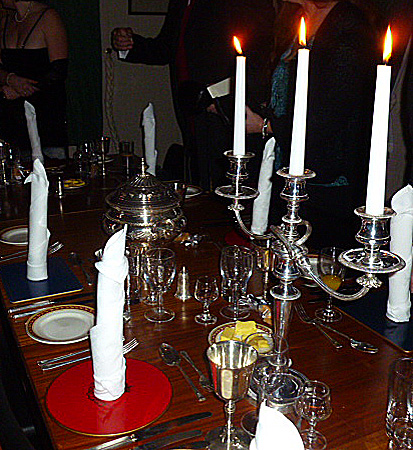
Silver service from top to bottom at the Raglan Officers' Mess.
If you’ve never been to an officer’s mess, let me explain: it’s not messy and it’s not like a canteen. No, an officer’s mess is formal dining defined. The dining room’s handsome wooden tables were laid with fine china, regimental silver red wine glasses, candelabras, enough silver eating utensils to choke even the largest dish washer, and elegant port wine glasses alongside crystal white wine glasses. Candles and low lighting set the mood as we found our places amid the elegance.
That elegance didn’t last long. Suddenly our baritone, Karl Daymond of the Wales Opera Playhouse, appeared in a Viking cap, to which two long braids were attached. His fingers danced across the keys of his electronic keyboard and his impressive operatic voice told us we were in for an evening of fun! The Viking was replaced with silly hats, signs, patter and a toothful grin that appeared whenever a camera was pointed its way. He worked the crowd of strangers into a table full of great friends in only minutes with his easy manner and retorts with all seated in front of him. His was the warmth that melted the ice.
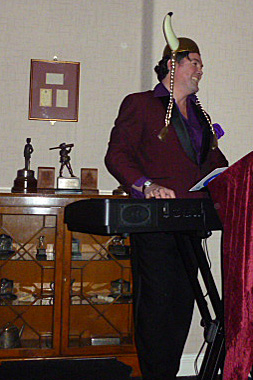
Karl Daymond's rich Welsh baritone voice entertained throughout the evening!
The most delicious homemade, sun-dried tomato bread preceded the panfried wild garlic mushrooms that were served over toasted brioche. They were followed by very slowly cooked Welsh shoulder of lamb topped with a rosemary and redcurrant jus, butternut squash and celeriac, Dauphinoise potatoes, buttered carrots and crispy kale. Welsh songs, anthems, jokes, a lot of oomph-ing and even a long-running Tom Jones tribute with the entire crowd joining in for a rousing “Delilah” linked the courses, and the participants.
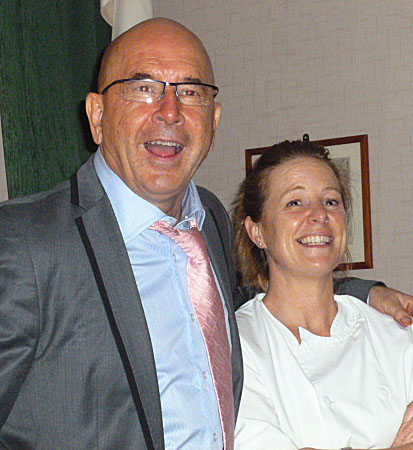
Impressario Phillip Mungeam and Chef Emma Evans earned their applause!
As we left the Officers’ Mess, strains of “There’s a Welcome in the Hillside” were heard coming from the open windows of the Sergeants’ Mess. Whether the singers were wearing kilts or tuxedos didn’t matter. Their voices blended in rapturous harmony and seemed a fitting end to a truly Welsh evening. It was the most fun Paul and I had had in “yonks,” and we cannot wait for the next installment of The Secret Supper Clwb. When and where will it be? That’s a Secret!!!!
A NOBLE DAY
Paul and I were in America when into my inbox arrived a query from a lady, Lisa Birkbeck, who was the researcher for a BBC Radio Wales program. Roy Noble, who had an afternoon slot, might be interested in interviewing me. On air. Me? Why? And How did Lisa find me?

- Roy Noble, Jann and Paul Seal in the BBC Radio Wales Studios
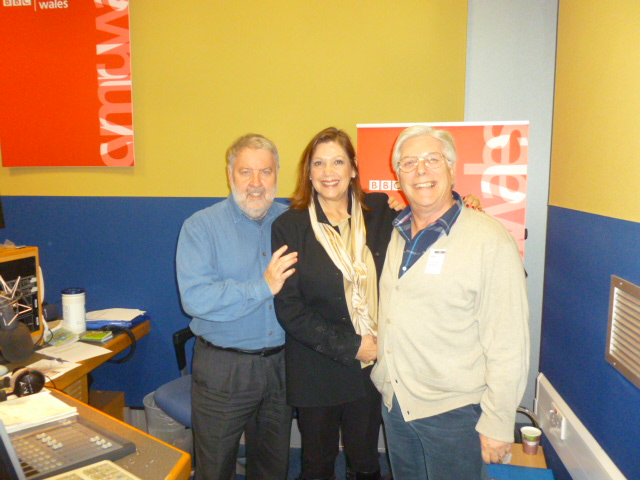
It seems that a good researcher finds good material, and I was one of them. Ahem. Lisa had found my blog (“Living Dibley,” the one you’re reading now) and thought that interviewing an American living in Wales and presenting her point of view just might make a lively few minutes. I told Lisa when we’d be returning to Wales, and we made arrangements to communicate – after the jet lag wore off.
True to form the intrepid researcher shot me another email just days after our return, and a date was set for me to come to the Cardiff studio to record, live, with Roy Noble.
Mr. Noble, Roy, as we are now on a first-name basis, is a teddy-bear kind of guy with a Father Christmas twinkle peeking out above his snowy beard. A coal miner’s son who was born in and still lives in South Wales, Roy speaks with the dancing lilt of a Welshman and his words come out surrounded by the mellow tones that only a true Welsh male voice can produce.
Roy had done his homework, read my blog, and knew a bit about my travels around the world when I was a young college graduate. He was fascinated by how many moves I had made in my adult life (coming up to 24, not including the one that was to take place the day after the interview.) I explained that I was a “ten year” girl, and moving every ten years was somehow wired into my genetics.
He was fascinated by how I had adjusted to living in South Wales. How did I feel about the food compared to that in America? What a no brainer! The food here is far superior, fresher, has traveled less distance before appearing in the market, and tastes like the food it looks like. Next? Customer service. Hands down, Wales. Not since I moved here has anyone asked me if I want to hear the instructions in Spanish, like they do in South Florida.
My meeting a Welshman online and then marrying him when he came to America intrigued Roy. He chuckled recalling the persuasive powers of Welsh men and I assured him that Paul’s Welsh roots were true to form!
Other countries came into the conversation and again, Wales came out on top, especially for beauty. When I added the fascination of Afghanistan and Iran, granted it was 40 years ago, an exotic element came into the conversation.
Roy had traveled to America when he was a headmaster and had been invited into homes throughout the States. He remembers fondly Arizona and Rhode Island, but was never intrigued enough to pack up his bags and move across the pond. His Welsh blood runs deep. His nationality is Welsh. He speaks fluent Welsh. He’s a true and respected citizen of Wales. So it was with a bit of shame that the only words I could repeat in Welsh were Cymru (Wales) and Croeso (Welcome).
It took me a few days to listen to my interview on the computer. I never remember, after the fact, what I say when I’m on radio, television or in front of a print reporter. It was only after hearing the playback of the interview that I regretted not having more time to share my enthusiasm for this lovely country.
What I can say here, and did say on air, is that THIS American is besotted with her new country.
Croeso i Cymru
THE GOOD, THE BAD AND THE GOOD AGAIN
After spending almost three months away from my beautiful Welsh countryside, and having missed what was described to me as a lovely Welsh summer, my return home last October created an anticipation that surprised, and pleased, me. The death of my mother, and the horrendous betrayal handed to me by some members of my family, wore me out. I stepped off the plane and immediately booked an appointment with my doctor. The heart palpitations, painful headaches, tight shoulder muscles and sleepless nights punctured by nightmares and unwritten and unspoken dialogue, had taken their toll. I was a mess.
All I wanted to do was to sit on my terrace, hold a cup of tea, and look out at the spectacular scenery that unfolds in front of me. Three mountains (hills, bumps – I call them mountains, as do most citizens of this prideful country) – Blorenge, Skirrid and Sugar Loaf stand proudly in the near horizon. The day could be cloudy and gray, but most often the clouds tear away when they are above these peaks and a streak of sun shines down, illuminating their majesty. I dreamt of this view, and the hot tea poured into my porcelain mug warming my hands, when I was going through the “terribles.” There was comfort in these thoughts.
My return to Wales was the good.
I was looking forward to going back to Florida and spending Thanksgiving and Christmas with our daughter, son-in-law and two very special little boys, our grandsons. We missed them terribly last year during the holidays and I had vowed not to spend another Christmas away from their lively faces and tender hugs and kisses. Recreating Thanksgiving here in Penperlleni last year provided a salve of sorts, but my heart still ached by the vacancy the separation created. My tickets had been booked months before and I wasn’t going to change them.
Just a few days before we were to leave for Florida I was told my father had taken ill and was in the hospital. The good people at Delta Airlines took matters into their own hands and managed to re-book both my husband and me, and to reroute our trip so we could get to the hospital on the west coast of Florida as quickly as possible. Fees were waived. Flights were rearranged, and before I knew it we were onboard and heading for the States.
I said my goodbyes to the man in the hospital bed who wore my father’s identification band. It wasn’t my father who was lying in that bed in the intensive care unit. He didn’t look like my father. His hair was different. His chin was more prominent and his nose had changed. Is that what age and illness does to a person? He had lost his wife only two months earlier and I guess Dad had decided he’d had enough. I said my goodbyes, remembering the person who “was,” not acknowledging who he had morphed into. Shortly after Thanksgiving, Dad joined Mom in the hereafter.
That was the bad. But ugly lurked on the horizon.
I cannot stress enough how important it is for EVERYONE to put their affairs in order and to make sure all siblings are in tune to parents’ wishes. My siblings ignored what my parents had established and took matters into their own hands, distributing the “booty” with a glee that sickened me. My mother’s wishes for a specific inheritance dedicated to me was snatched away under the auspices of a power of attorney. The legal cost to prosecute was more than the stolen funds amounted to. I walked away with much less than my siblings. But I also walked away with the knowledge that it wasn’t I who had trampled on my parents’ graves.
So ended the bad.
Returning to the east coast of Florida, my beautiful daughter, handsome son-in-law and delicious grandsons enveloped me in hugs that lasted forever. Our friends stood in line to invite us into their homes. The welcome we received after such a horrendous few days that had split my world in two, revived the mending process that the previous six weeks in Wales had started.
My bad dreams started to go away. The heart palpitations ebbed. The throbbing in my head”Dear Santa, We bought you some red roses. We hope you like them. Love, Jacob and Nicky.” calmed. The tension in my shoulders began to subside. The love we were given helped erase the miseries and reminded us of all the goodness that is in our lives.
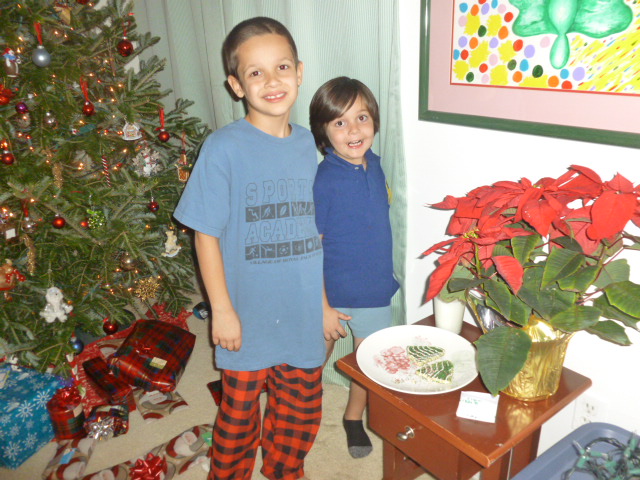
"Dear Santa, We bought you some red roses. We hope you like them. Love, Jacob and Nicky!"
We spent a long six weeks in Florida, eating, laughing, drinking, hugging, crying and then eating and drinking some more. I shopped with my daughter. We took a two-day road trip with our grandsons, exploring Butterfly World and Billie’s Swamp Safari. It’s amazing what most impresses children. Not the iridescent blue morpho butterflies, not the treasures purchased in the gift shop, not the meatballs swimming in sauce or macaroni and cheese they had for dinner. No. It was the sheer delight that was in Jacob’s voice when he walked into our hotel room for the first time. “Grandma, it has a microwave! Thank God!” Those seven words reduced all my woes to nothingness as what was important in my life stood in seven-year-old amazement in front of me.
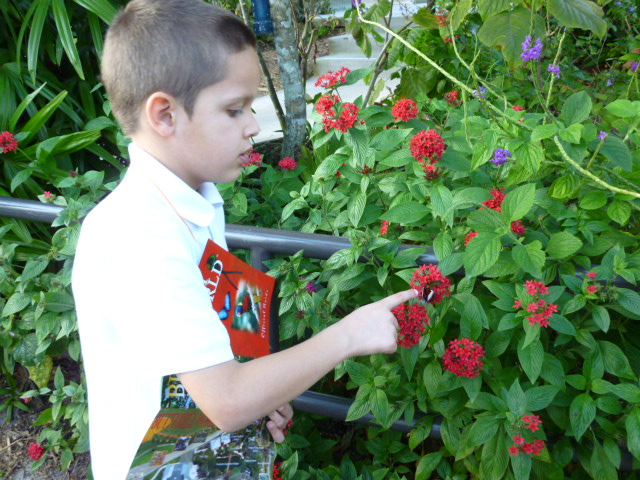
"I'm never going to wash my finger again. It touched a butterfly!" Jacob at Butterfly World
Two weeks before we were to return home I was ready. I missed my home. I missed my countryside. I missed the civilized people of Wales and their lilting voices. I missed my fresh market, real vegetables pulled from the ground and still covered in rich, Welsh earth, lambs dotting the countryside, trees that had limbs almost down to the ground, weather, green rolling hills – I missed Wales.
I’m home now. 2012 lays ahead of me full of promise. 2011 was regurgitated as the clock neared midnight on New Year’s Eve, and the bad was flushed away. Only good remains as only good is allowed in my life from this point forward. For me, the good is what stretches out from my children’s arms and reaches across the ocean to my husband and me, and our life in this glorious country that is Wales.
OF PUFFANS, PELICANS, TOUCANS AND ZEBRAS
I’m sitting in the lobby of the BBC in Cardiff, waiting for my appointment with the Director of Commissioning where I’ll present a few ideas for Welsh television. Not wanting to waste time, I’ve brought along a titillating book to read: “The AA Theory Test for Car Drivers.” Inside are 963 official questions and answers I must learn and memorize before taking the UK driving test.
This is the third time I’ve driven from my home in the countryside into the city. My stomach’s been nervous all day. My fingernails serrated. It’s not the meeting that’s causing all this, but the fact that once again, I have to do battle with my demons – and drive.
Mind you, the British drivers are not at all intimidating. They’re really quite lovely and are bursting with good manners. They wave at you to turn from one lane to the other, and actually wait while you do so. And then they wave again after you’ve turned. The Japanese may be masters of the bobbing head, but the British have the polite hand wave down pat. They wave when you let them into your lane. They wave when they have to back up into a driveway or a small lay by so you can proceed down a crowded lane. They stop on a busy street to let you pull out. And they wave when you do.
The British signs even have manners. “Keep Cardiff Tidy,” read one I passed today. We do.
And then there are the birds and animals that share the roads with cars. Puffins, penguins, toucans and zebras are everywhere. They’re not escapees from the zoo but different types of road crossings every driver must learn to distinguish and obey the rules for. The definitions lay buried somewhere in the CD that accompanies the book.

- Do you see any zebras?
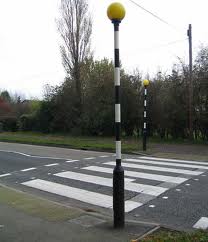
Ok. The next time I see a penguin, or a puffin or a zebra crossing the street, I’ll simply stop the car, turn off the engine and wait. For what I don’t know but I’ll be well-mannered, wave at the animals as they cross, and read a few more pages of my AA Theory book in preparation for the driving test that already is giving me nightmares.
Any bets on my passing the first go-around? Driving lessons start this weekend…..
HOME, AGAIN
I left my lovely Welsh cottage in mid-July, heading for the one place in the world I tried hard to get away from, especially in the summer: South Florida. Have you any idea what Florida is like during the summer? For your sake, I hope not.
Mom - Dorothy Briggs
The good points of Florida are: my daughter, her husband, my two little munchkins, Jacob and Nicholas, and my parents. Unfortunately, my call back to the Land of Strident Sunshine and Hovering Humidity was not for good things. My Mother, a lively woman of 88, was ill and needed taking care of. Dad was already under care at my brother’s home, but Mom had suffered a fall, was being released from the hospital and wasn’t capable of living alone. So, all the balls I had floating in the air in search of a career commitment came crashing to the floor — and I headed for Heathrow.
The next 2 ½ months were good, bad and ugly. Mom and I spent many lovely evenings together, talking, remembering and singing. Every road trip we took when I was a child was accompanied by song: war tunes my mother remembered dancing to at New York City’s Palladium during World War Two; the great American songbook performed on stage in Broadway musicals; songs reminiscent of her youth – and mine. The tradition continues today as little Nicholas is now learning the same songs as we drive along.
We came to an understanding, and forgiveness, about all the horrible things a daughter remembers about her upbringing, whether true or not.
I learned more about her life growing up in New York City, attending Cooper Union College and becoming a draftsman for the Navy during World War Two. I also heard the stories about how hard it was for a woman to find a drafting position after all the men came home from the war, and how she turned to waitressing just to earn a living and supplement my father’s income.
My life was taking on a new meaning as I saw it through her eyes. And she learned about my life that went beyond all the husbands, careers, adventures and travels. We got to know each other for the first time in both our lives. Her words to me one night as she went to bed were, “Do you love me?” Of course I love you, Mom.
That was the last of our conversations. Mom fell the next morning and was rushed to the hospital, bleeding, shaken and semi-conscious. She never fully recovered, and left us one month later, under the care and loving concern of the Hospice wing at her hospital. I kissed her hello as I walked into her room the afternoon of September 15. She took a breath — and then quietly slipped away.
At her memorial I spoke about my mother being “a hoot.” And she was. She was the first to hop onto the dance floor at my daughter’s wedding, shaking her 83-year old bottom and waving her arms with glee. She also managed to stuff several leftover steaks into her handbag to take home to her dog. Most old ladies steal bread and rolls from restaurants. My mother took china dishes, salt and pepper shakers, and steak. Her local casino probably had her on their high alert cameras whenever she strolled in with her accomplice – a large, gold-studded handbag!
We went to Portugal together and spent two weeks eating, dancing and touring with my daughter and friends. We took a cruise. We planned road trips that were never taken. One evening, during her last week at home, she looked at me longingly and asked if we could move to Paris for a year. Her energy was abundant, her dreams never ceasing. Until the end.
My Mom had had enough. Life had been reduced to moving around with a walker or a wheelchair. Those simple confinements cut the artery of life that fed her. She shut down. Her doctor likened her withdrawal from any nourishment to the rituals of the Eskimo. And like the Eskimo who has reached the end of life, Mom put herself on an iceberg and floated out to sea. She simply wrapped herself in a pile of blankets, cuddled up in her favorite quilt, and climbed onto her own iceberg that would take her to the end of her journey. Travel safely, Mom.
LEAVING DIBLEY
My mother isn’t well. The phone call from her doctor told me she had had a mild TIA (stroke) and that living alone was no longer an option. My brother has his hands full taking care of my father. There was no alternative. I had to go back to Florida to take care of mom.
That’s where I am now. In Florida. In the heat. In the summer. Wasn’t that why I left Florida? As John Lennon once sang: “Life is what happens when you’re making other plans.”
I had ten glorious months in South Wales. I made some lovely friends. Ate gorgeous food. Sat spellbound looking out at my mountains. Fell in love with baby sheep. And was surrounded by the sweetest people I had ever met.
But for now, my mother needs me. We sit on the sofa and talk. Her long-term memory is sharper than I’d ever known; it’s only words pertaining to yesterday’s Oprah show that seem to melt into the puddle of her short-term memory. She picks at her food but takes her tablets like a good girl.
Mom looks forward to seeing her doctor, having her physical therapy and spends her days lying on the sofa watching one reality show after another. She knows all about the Kardashians. Is on a first-name basis with the Housewives of New Jersey, Atlanta, Beverly Hills and, of course, New York. The ladies on “The View” wait for her to tune in. And then there’s “Oprah.” Mom said goodbye to Oprah’s show, but not until I taped at least 25 episodes from this last season. We watch them together, over and over again.
My job is to take care of my mother, so the hills of South Wales will have to wait for me to return. But unlike my forefathers who set sail from Wales to America almost 400 years ago, I won’t wait that long before coming back. When you see a crazy driver in a rickety old blue car tooling down the road on the “other” side, smashing into bushes and driving over curbs, you’ll know I’ve returned! Hyd nes y byddwn yn cyfarfod eto…
No Joy in Mudville
It was a black blob. Lying in the meadow just beyond our lawn. A wire fence separated us. Tall weeds shielded it. I had an idea what it was, but I didn’t want to admit it.
Our little cottage is surrounded by three meadows: the gently sloping south meadow, bordered by a lovely stone house, ancient trees, hedges and gardens; the adjacent west meadow that parallels our coach house and has a burial mound at its top (not people, just building refuse), and the north meadow that rises from the west and leads to a stand of trees where our (no, they’re not ours, but their welfare has become our watch) sheep tuck under for a bit of shade during their afternoon naps.
Rotating in and out of our meadows are three sheep families. Beige mama has two little beige babies who have eaten their way through the pastures and are getting quite chubby. Black sheep mama #1 has two little black sheep babies and black sheep mama #2 has two brilliantly white baby lambs that Paul watched being born (whereupon he immediately sent out birth announcements.) Genetics played a hand here.
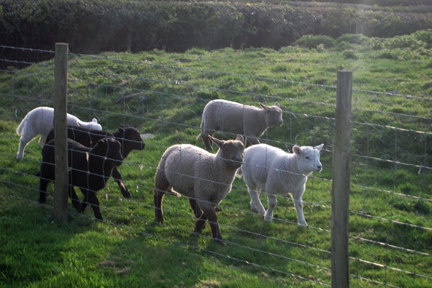
Babies at Play
Our little families move from meadow to meadow, filling their bellies, lying idly in the sun, monitoring a “kid-der garten” of sorts as the little ones chase each other around and around and around. Bonking heads, mounting the one female and being chased away by mama, a little brown horn pushing its way upward on a little lamb head – these are our daily snippets of entertainment whenever we look out the window or walk out to the terrace.
They talk to us. We park our car in the gravel driveway and see little faces baa-ing away. They’re telling us about their day. Complaining about the grass. Wondering where their pals are. Or just saying hello.
They’re not particularly beautiful. In fact, the mamas are kind of scruffy and unkempt. But they have gotten under our skin and we’ve learned from them. They know who their babies are. They guard them. Guide them. And the babies trail close behind whenever mama moves to a different part of the meadow.
One afternoon when I was away, Paul heard a continuous baaaaaa outside near the terrace. One of the beige babies had found his way into our backyard and needed Paul’s help. Grandpa Paul led him around to the meadow gate and reunited him with his family, stepping in a pile of poo along the way. Oh, the things you forgive when you have children.
We’ve been offered the opportunity to purchase a spring lamb, butchered and ready to eat. I don’t know if I could eat it, having become emotionally attached to our animal families who live outside. It’s like fishing. I can’t eat what I catch. Or chickens. I can’t eat what I saw living a few minutes before. No. No spring lamb for me.
I emailed our landlord about the black blob. Within an hour the farmer had been alerted and had discovered the dead sheep. It seemed a dog had gotten to her. How, I don’t know. Why? Well, it’s the country, isn’t it? Animals do what animals do. It’s called nature. But in our little corner of Wales, where the hills are green and the mountains poke their heads out of the valleys, where melodious voices reach out of the valleys and where ancient temples still stand – in our little corner of heaven, today, there is no joy in Mudville.
My thanks to the poet Ernest Lawrence Thayer’s “Casey at Bat.”
Raising My (Gardening) Hat to Ground Huggers
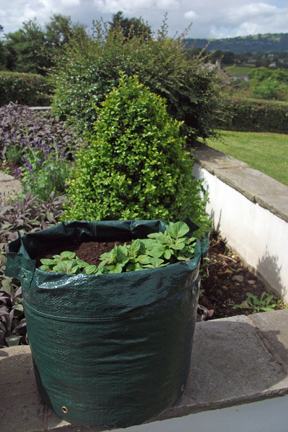
Paul's Potato Patch
I’m a wall hugger. I’ve always been in awe of buildings that
were older than the few years America has been in existence. I remember sitting in a village square in Arraiolos, Portugal, eating creamy custard tarts with my daughter Cashley and our friends Valerie and Ralph, and noticing a beautiful
stone archway at the edge of the square. I walked over and read the plaque: it was built in 947 AD — 1,000 years before I was born! ONE THOUSAND YEARS! That alone was worth a hug, and as I wrapped my arms around the archway I trembled,
knowing how much history had passed through that doorway.
But I divert. Prince Philip said in a recent BBC interview celebrating his 90th birthday that he was not a “bunny hugger.” I rather doubt that wild rabbits hop the fields of the many castles where he resides, and if they do, it isn’t long before they end up as Sunday dinner. I like bunnies, and am amused at the daily entertainment they provide when I look out the windows
and see all the generations hopping merrily through our fields. There were four
of them in my driveway when I looked out the window, lined up as in morning
assembly. The British are known for their love of the land, so I am now dubbing
them “ground huggers.” I guess we all have to have something to hug.
I’ve lived in a lot of places and nowhere have I seen such a
riot of garden television programs, garden centers, garden books, plants,
flowers, trees, blossoms – the British love their gardens and I know they’re
all born with green thumbs. Pity the ones who aren’t because they’ll be found
out and shipped out of this lovely island.
I’m not British so I can boast of not having a green thumb
without fear of extradition. But my husband, Paul, is enthralled by gardens. (He’s Welsh, therefore British.) Not that he has much to do with them when it comes to maintenance, but sticking
a seed or plant into the earth and watching it sprout amazes him. It amazes me
too because without so much as a hug, his earth parts and little leaves make
their entrance. Like the potato.
Paul bought a potato bag. That’s all it was. A plastic bag
with reinforced threads running through it and little holes at the bottom for
drainage. No dirt. No potato. No nothing. Just a bag. Fortunately we had some
compost in the pig sty (that’s another story) and he poured it into the bag,
grabbed a potato from the kitchen counter, stuck it in, covered it, and waited.
Michael, the groundskeeper who knows everything about gardens (he IS British
after all and is in no fear of having to pack his bags) suggested he add a
friend potato to the bag so the potato wouldn’t be lonely. There went dinner.
We waited. Paul walked out to the terrace every morning to
check on his potato bag, but no sign of life was threading its way through the
dirt. I moved it into a sunnier area and watered the little guys when we had
our two days of dry summer. And we waited some more. Until the glorious day arrived
when a sprout appeared! Tiny, almost invisible, its little green head had popped
through the soil and waved to us. (It might have been the wind blowing it
around, but we prefer to think it waved.) The next day, some friends joined
him. And the next, and the next, and the next! A little village of green leaves
had moved in and our potato crop was on its way!
In a country where the BBC devotes an hour of prime time
television to the apple, and where my yoga teacher, Audrey, exclaims with glee
that her queen bee has laid eggs, we watch in awe as Paul’s green thumb bares
its British-ness and joins the millions of others all around us. I guess he
doesn’t need to pack his bag and hop a ship in Plymouth. The pilgrims did it
hundreds of years ago. They must have been the black thumb brigade because they had to
rely on the Indians to show them how to plant, sow, reap and harvest. Hail Britannia
— and all the ground huggers who live here.


 Living Dibley's Blog